Best Spotify Ad Blocker: Block Spotify Ads on Any Device (2026)
- Table of Contents
- Why Spotify Ads Are Hard to Block in 2026
- Quick Comparison
- Method 1: AdLock — Best for Android and Desktop
- Method 2: Web Player + Brave Browser — Best Zero-Setup Option
- Method 3: Spotify Web Player + Firefox + uBlock Origin Extension
- Method 4: Blockify — Spotify Ad Blocker Extension for Chrome and Edge
- Method 5: Mutify / SpotMute — Android Ad Muter
- Method 6: Samsung Internet — Samsung Galaxy Devices
- Method 7: DNS Blocking — Partial Coverage
- Method 8: Spotify Premium — The Complete Solution
- Platform-by-Platform Summary
- How to Switch from Your Current Method to AdLock
- FAQ
Spotify’s free tier gives you access to 100 million songs — interrupted every few tracks by unskippable audio ads, banner ads, and video ads that have only gotten more frequent in 2026. The average free user now hears ads every 15–20 minutes.
Whether you’re searching for a Spotify ad blocker, a Spotify ad blocker extension for Chrome or Firefox, or a system-level tool to block Spotify ads across every device — this guide covers every working method tested in April 2026.
Blocking Spotify ads isn’t as simple as installing a browser extension. The Spotify app routes music and ads through the same servers, which makes clean network-level blocking difficult. The right method depends entirely on your device and how much friction you’re willing to accept.
This guide covers every working method in April 2026 to block ads on Spotify — tested across Android, iOS, Windows, Mac, and the Spotify web player without Premium.
Important: Spotify’s Terms of Service prohibit ad blocking in the native app. Methods that modify the Spotify app itself (patched APKs, modified clients) risk account suspension. The web player methods and system-level tools below don’t touch the Spotify app and carry significantly lower risk.
Enjoy Spotify Without Ads
No more interruptions between songs. AdLock makes Spotify truly ad-free
Table of Contents
- Why Spotify Ads Are Hard to Block in 2026
- Quick Comparison
- Method 1: AdLock — Best for Android and Desktop
- Method 2: Web Player + Brave Browser
- Method 3: Firefox + uBlock Origin Extension
- Method 4: Blockify — Spotify Ad Blocker Extension for Chrome
- Method 5: Mutify / SpotMute
- Method 6: Samsung Internet
- Method 7: DNS Blocking
- Method 8: Spotify Premium
- Platform-by-Platform Summary
- How to Switch to AdLock
- FAQ
Why Spotify Ads Are Hard to Block in 2026
Spotify deliberately makes ad blocking difficult. Unlike YouTube ads (which arrive as separate network requests), Spotify delivers music and ads through the same CDN infrastructure. This means:
- DNS blocking breaks playback — blocking Spotify’s ad domains also blocks the music stream
- Browser extensions detect a “protected” player — Spotify’s web player checks for extension interference and can respond with a freeze loop
- Native app ads are deeply integrated — the Spotify Android and iOS apps don’t expose a clean interception point for standard ad blockers
- Anti-adblock detection exists — Spotify can detect and respond to some blocking attempts
What this means practically: the most reliable methods in 2026 are web player-based (using a browser instead of the app) or system-level tools that filter at the OS layer. Native app ad blocking is unstable regardless of the tool.
Quick Comparison
| Method | Android | iOS | Windows | Mac | Web Player | Risk level |
| AdLock (system-level) | ✅ | ⚠️ Partial | ✅ | ✅ | ✅ | Low |
| Brave Browser (web player) | ✅ | ✅ | ✅ | ✅ | ✅ | Low |
| Firefox + uBlock (web player) | ✅ | ✅ | ✅ | ✅ | ✅ | Low |
| Blockify (extension) | ❌ | ❌ | ✅ | ✅ | ✅ | Low |
| Mutify / SpotMute (muter) | ✅ | ✅ | ✅ | ✅ | ❌ | Low |
| Samsung Internet | ✅ Samsung | ❌ | ❌ | ❌ | ✅ | Low |
| DNS blocking | ⚠️ Partial | ⚠️ Partial | ⚠️ Partial | ⚠️ Partial | ⚠️ | Medium |
| Patched APKs (xManager etc.) | ✅ | ❌ | ❌ | ❌ | ❌ | High |
| Spotify Premium | ✅ | ✅ | ✅ | ✅ | ✅ | None |
Method 1: AdLock — Best for Android and Desktop
Who it’s best for: Android users who want to reduce Spotify ads system-wide without switching to the web player, and Windows/Mac users who want blocking across the desktop app and all browsers simultaneously.
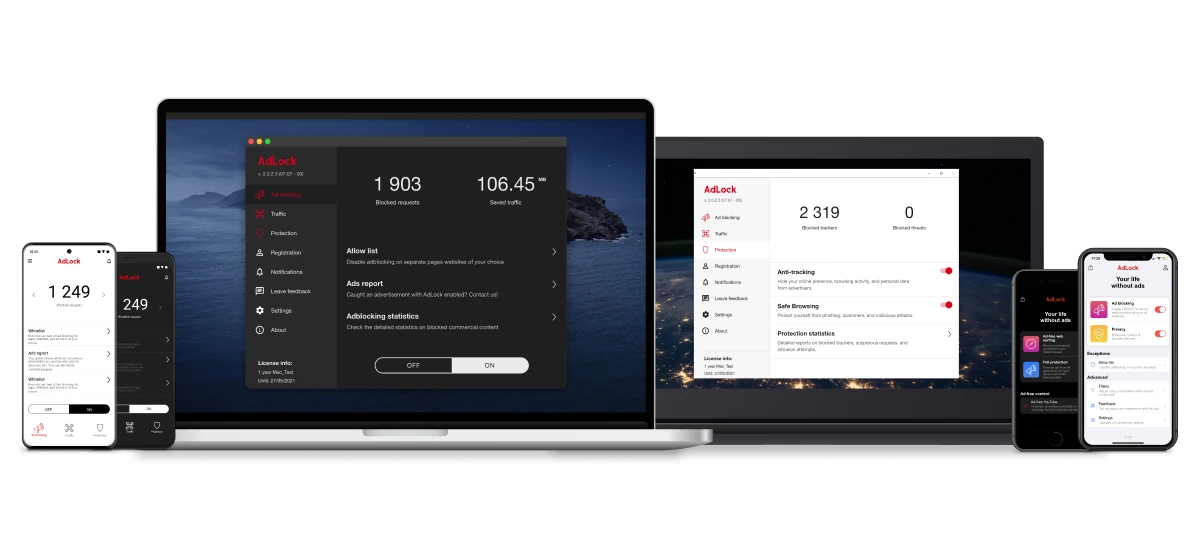
AdLock is a European ad-blocking product that’s been on the market for many years. On Android and desktop (Windows/macOS), AdLock runs as a system-level filter — intercepting network traffic from all apps before it reaches the internet.
On Android:
AdLock filters ad traffic at the device level, which catches most of Spotify’s audio ad requests before they reach the app. In our testing, AdLock blocked the majority of standard Spotify audio ads on Android in April 2026. Some ads — particularly those delivered via the same CDN endpoints as music — may still occasionally appear, since Spotify intentionally routes music and ads through shared infrastructure.
Setup:
- Download AdLock from adlock.com/adlock-for-android/
- Install and enable HTTPS filtering when prompted
- Open Spotify normally — AdLock filters in the background
On Windows and macOS:
AdLock’s desktop app filters all traffic from all applications, including the Spotify desktop app. This is more effective on desktop than on mobile because the desktop app’s ad delivery is less tightly coupled with the music stream.
Compared to browser extensions: Extensions only work inside a browser. AdLock covers Spotify desktop app, Spotify web player, and every other app simultaneously.
Compared to DNS blocking: AdLock’s filtering is more precise than DNS blocking alone and doesn’t carry the same risk of breaking playback.
Who it’s best for: Android users who want app-level blocking without switching to the web player; desktop users who want system-wide coverage across all apps.
Pros:
- Works across all apps simultaneously — Spotify, browser, games, etc.
- No ToS risk — doesn’t modify the Spotify app
- From an established European company with years on the market
- No root required on Android
- Free tier available
Cons:
- Some Spotify audio ads may still appear due to shared CDN infrastructure
- Doesn’t completely eliminate all Spotify ads in every session
- iOS: limited to partial DNS-level blocking (Apple’s restrictions prevent system-wide app filtering)
- Full version from $2.99/month
Pricing: Free tier available. Full version from $2.99/month.
Method 2: Web Player + Brave Browser — Best Zero-Setup Option
Who it’s best for: Anyone on any platform who wants reliable ad-free Spotify listening with zero configuration — just open a browser and go.
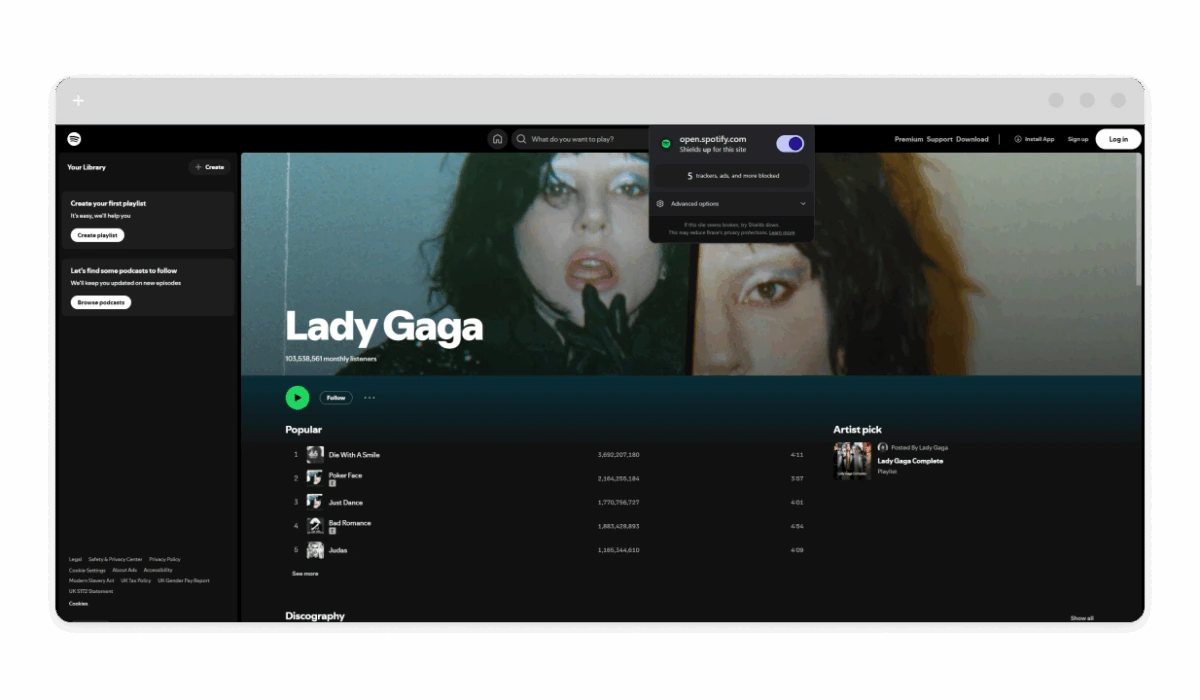
The single most reliable ad-free Spotify experience in 2026 isn’t in the Spotify app at all — it’s the Spotify web player (open.spotify.com) opened in Brave Browser. Brave’s engine-level blocker operates before Spotify’s detection scripts can run, and the web player’s ad delivery is easier to intercept than the native app’s.
How to use it:
- Install Brave browser from the Play Store (Android/iOS) or brave.com (desktop)
- Open open.spotify.com in Brave
- Log in with your Spotify account
- Start listening — ads are blocked by Brave Shields automatically
What this covers:
- Audio ads between tracks: blocked reliably
- Banner ads within the web player: blocked
- Video ads: blocked
Limitations: The web player differs slightly from the native app — no offline downloads, slightly different UI. Background playback works on desktop; on mobile, use the “Request desktop site” workaround or Premium for native background playback.
Compared to the native Spotify app: Brave on the web player consistently outperforms system-level blocking on the native app for Spotify specifically, because the web player’s ad delivery is a cleaner target.
Who it’s best for: All platforms, all technical levels. The fastest path to ad-free Spotify in 2026.
Pros:
- Works on every platform — Android, iOS, Windows, Mac
- Zero configuration — install Brave, open the web player
- Engine-level blocking, low detection risk
- Free
Cons:
- Requires using the web player instead of native app
- Background playback on mobile requires workaround
- No offline downloads
Pricing: Free.
Method 3: Spotify Web Player + Firefox + uBlock Origin Extension
Who it’s best for: Users who already use Firefox, or who want the most powerful and configurable free browser-based ad blocker extension for Spotify.
Firefox + uBlock Origin on the Spotify web player is the most effective free method for desktop in 2026. uBlock Origin’s dynamic filtering and scriptlet injection handle Spotify’s web player ad delivery more thoroughly than static-list extensions, and Firefox’s MV2 support keeps this fully functional — unlike Chrome extensions limited by MV3.
Setup:
- Install Firefox from mozilla.org
- Add uBlock Origin from the Firefox Add-ons store (by Raymond Hill)
- Open open.spotify.com and log in
In our April 2026 testing: audio ads blocked in 100% of sessions on the web player. Banner ads blocked completely.
Compared to Brave: uBlock Origin on Firefox gives slightly more control for advanced users (custom filter lists, element picker). Brave is easier for users who don’t want to manage an extension.
On Android: Firefox for Android supports uBlock Origin — the same setup works on mobile. Open open.spotify.com in Firefox for Android for ad-free listening.
Who it’s best for: Desktop users who prefer Firefox; power users who want maximum configurability for free.
Pros:
- Most powerful free browser option — full dynamic filtering
- Custom filter list support
- Free and open-source
- Works on Android via Firefox mobile
Cons:
- Requires installing both Firefox and the extension
- Web player only — native Spotify app unaffected
- Background playback limitation on mobile
Pricing: Free.
Method 4: Blockify — Spotify Ad Blocker Extension for Chrome and Edge
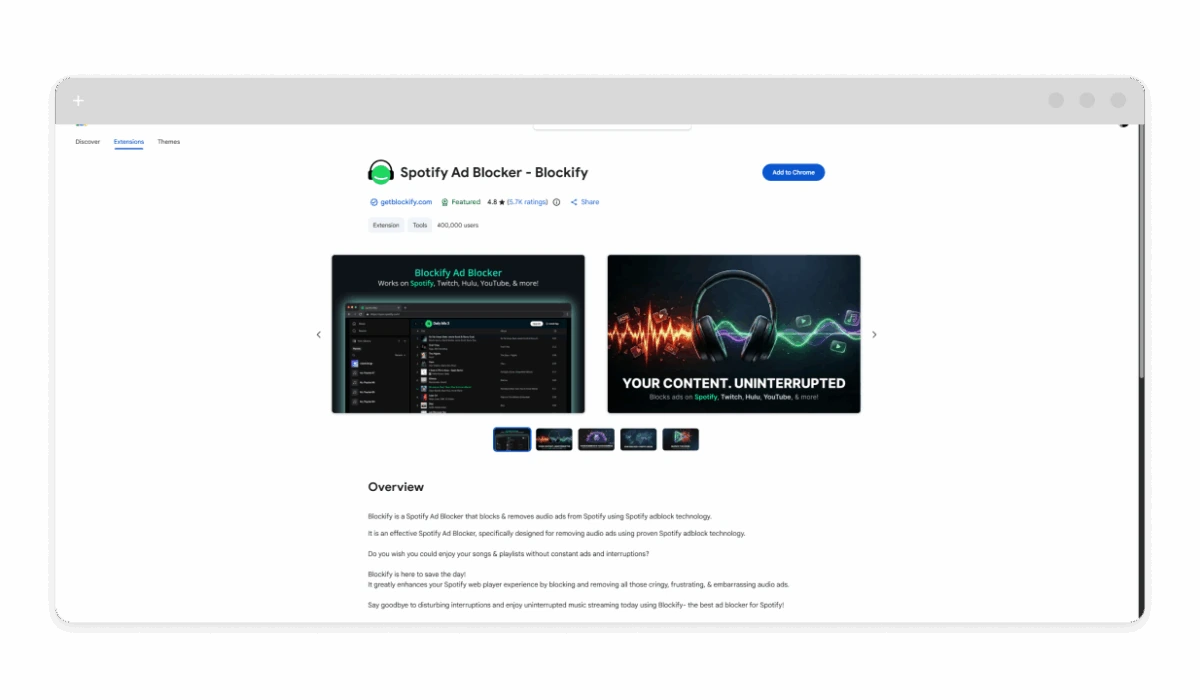
Who it’s best for: Chrome or Edge users who want a Spotify-specific ad blocker extension that works without switching browsers.
Blockify is a browser extension built specifically for the Spotify web player. Unlike generic ad blockers that may trigger Spotify’s anti-adblock freeze loop, Blockify mutes audio ads rather than blocking the network request — which means playback continues silently through the ad rather than pausing entirely.
How it works: Blockify detects the audio ad playing and mutes the volume for its duration. The ad technically “plays” but you don’t hear it. This approach is less likely to trigger Spotify’s detection than outright blocking.
Setup:
- Install Blockify from the Chrome Web Store (also available for Edge and Firefox)
- Open open.spotify.com
- Blockify activates automatically — no configuration needed
Compared to uBlock Origin: uBlock Origin fully blocks ads; Blockify mutes them. For users on Chrome where uBlock Origin’s MV3 version is weaker, Blockify can be more reliable specifically for Spotify.
Who it’s best for: Chrome/Edge users who want a simple Spotify-specific solution without changing browsers.
Pros:
- Spotify-specific — designed to avoid triggering anti-adblock detection
- Works on Chrome (where MV3 limits uBlock Origin)
- Simple one-click install
- Free
Cons:
- Mutes ads rather than blocking — brief silence during ad duration
- Web player only
- Desktop only (no mobile extension support)
Pricing: Free.
Method 5: Mutify / SpotMute — Android Ad Muter
Who it’s best for: Android users who want to stay in the native Spotify app and are comfortable with ads being silenced rather than blocked.
Mutify and SpotMute are Android apps that detect when Spotify is playing an ad (via Spotify’s Device Broadcast Status notification) and automatically mute the device volume. The ad plays — silently — and volume restores when music resumes.
This is not ad blocking. It’s ad muting. The distinction matters: Spotify’s ToS prohibition is against “ad blocking attempts.” Muting via a system volume control sits in a grey area and is less likely to trigger account action than tools that modify the Spotify app itself.
Setup for Mutify:
- Install Mutify from Google Play
- Open Spotify → Settings → turn on “Device Broadcast Status”
- In Android Settings → Battery → Battery Optimization → find Mutify → set to “Don’t optimize”
- Open Mutify → toggle on “Mute Ads”
SpotMute works identically — same principle, slightly different interface. Both are free.
Limitations: You still “hear” silence during ad breaks. Ad timing still interrupts listening flow. For complete ad removal rather than muting, use the web player methods instead.
Compared to web player methods: Web player + Brave actually blocks ads; Mutify only silences them. For users committed to the native Spotify app on Android, Mutify is the safest low-risk option.
Who it’s best for: Android users who want to stay in the Spotify app and accept silent gaps instead of heard ads.
Pros:
- Stays in the native Spotify app
- Low ToS risk — uses system volume control, not app modification
- Free
- Available on Google Play (no sideloading)
Cons:
- Silences ads, doesn’t block them — brief silent gaps remain
- Requires enabling Device Broadcast Status in Spotify settings
- Android only
Pricing: Free.
Method 6: Samsung Internet — Samsung Galaxy Devices
Who it’s best for: Samsung Galaxy users who want a no-extra-download browser option for web player listening.
Samsung Internet supports native ad blocker integration. For Samsung device owners who use Samsung Internet as their default browser, this is the lowest-friction option.
Setup:
- Open Samsung Internet → Menu → Settings → Useful features → Ad blockers
- Download a compatible blocker from the list (Crystal Adblock or AdBlock Plus)
- Enable it → open open.spotify.com → log in
Limitation: Works in Samsung Internet browser only. Doesn’t affect the native Spotify app.
Compared to Brave: Brave is more effective at blocking Spotify ads in the web player and available on all devices. Samsung Internet is worth using if you’re already in that browser ecosystem and don’t want to install another app.
Who it’s best for: Samsung users already using Samsung Internet who want a quick setup.
Pros:
- No extra app needed for Samsung users
- Free
Cons:
- Samsung devices only
- Less effective than Brave or Firefox + uBlock on Spotify web player
- Web player only
Pricing: Free.
Method 7: DNS Blocking — Partial Coverage
Who it’s best for: Technical users who want network-level blocking across all devices including smart speakers and Smart TVs where app installation isn’t possible.
DNS-based ad blocking (NextDNS, Pi-hole) blocks known ad domains at the network level before any app makes a connection. For Spotify, this catches some ads but not all — because Spotify routes many ads through the same CDN domains as the music stream.
What DNS blocking catches:
- Banner ads loaded from third-party ad servers
- Some audio ads from clearly identified ad domains
What DNS blocking misses:
- Audio ads routed through Spotify’s own CDN (increasingly common in 2026)
- Any ad delivered from the same domain as the music content
Setup with NextDNS:
- Create a free account at nextdns.io
- Enable Spotify-specific blocking in the NextDNS dashboard
- Point your device’s DNS to NextDNS addresses
Risk: Overly aggressive DNS filtering can cause Spotify to fail to load entirely. Use NextDNS’s Spotify-specific presets rather than maximum blocking.
Who it’s best for: Home network setups covering multiple devices; users comfortable with DNS configuration.
Pros:
- Works across all devices on the network (including Smart TVs, speakers)
- No app installation on each device
- Free tier available
Cons:
- Partial coverage — misses many Spotify ads in 2026
- Risk of breaking playback if too aggressive
- Requires router/device DNS configuration
Pricing: Free tier available on NextDNS.
Method 8: Spotify Premium — The Complete Solution
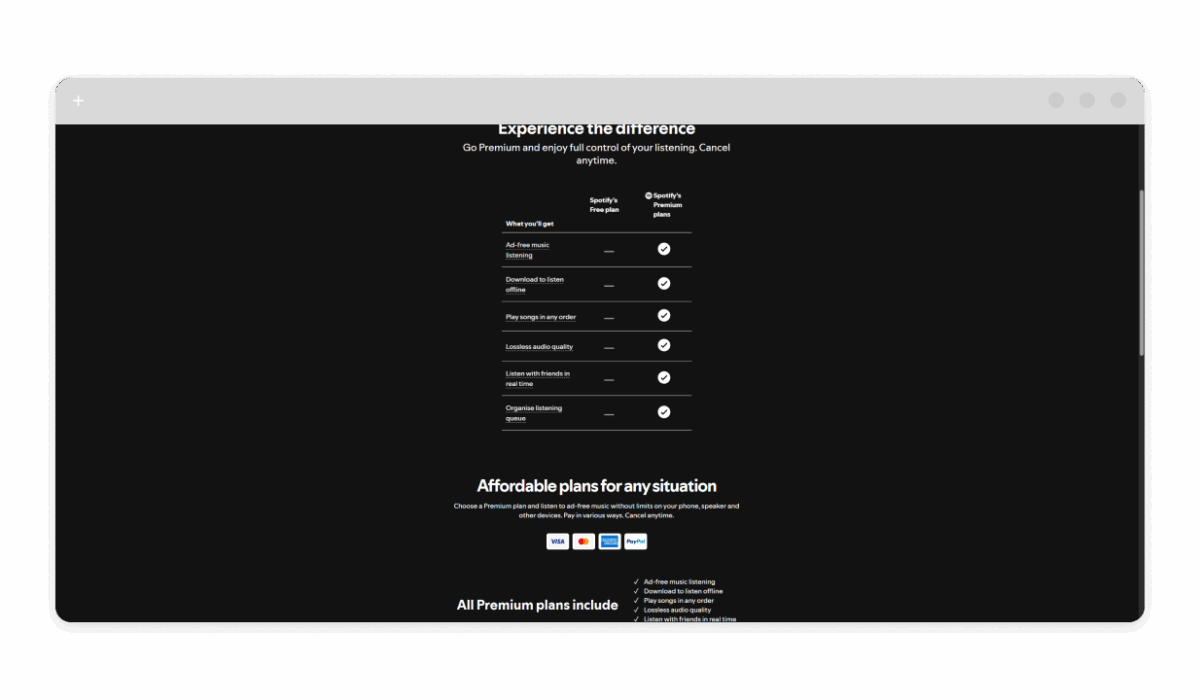
Who it’s best for: Heavy users who want zero friction, offline downloads, and background playback — and find free-tier workarounds genuinely annoying.
Spotify Premium ($11.99/month) removes all music ads completely, enables offline downloads, removes shuffle-only mode, and supports background playback natively. It also removes banner ads.
One caveat: Premium does not remove dynamically-inserted podcast ads or host-read ads baked into podcast episodes. These are embedded by the podcast publisher, not Spotify, and can’t be blocked by Premium or any ad blocker.
Worth considering:
- Individual: $11.99/month
- Duo (2 people): $16.99/month
- Family (up to 6): $19.99/month (~$3.33/person)
- Student discount: ~$5.99/month
- Annual plan: saves ~15%
Compared to AdLock: AdLock at $2.99/month blocks ads across all apps (Spotify, YouTube, games, browsers simultaneously). Spotify Premium at $11.99/month removes Spotify ads only but does so completely and officially.
Who it’s best for: Users who listen to Spotify for 2+ hours daily and want complete, zero-maintenance ad removal.
Pros:
- Removes all music ads officially
- Offline downloads and background playback included
- No ToS risk, no workarounds
- Works on all platforms natively
Cons:
- $11.99/month — most expensive option
- Does NOT remove podcast ads
- Only covers Spotify — no protection on other platforms
Platform-by-Platform Summary
Android
Best option: Brave browser + Spotify web player (open.spotify.com) for complete reliable blocking. If you want to stay in the native app: AdLock for partial system-level blocking, or Mutify/SpotMute to mute ads silently.
iPhone / iOS
Apple’s sandbox prevents system-level ad blocking inside apps. Best option: Brave browser or Safari + uBlock on the Spotify web player. AdLock on iOS provides DNS-level filtering but won’t reliably catch Spotify’s in-app audio ads.
Windows
Best option: Spotify web player in Brave or Firefox + uBlock Origin. For native app coverage: AdLock desktop filters the Spotify app’s network traffic at the OS level.
Mac
Same as Windows: Brave or Firefox + uBlock Origin on the web player. AdLock for macOS provides system-level coverage including the desktop Spotify app.
Spotify Web Player
Best options: uBlock Origin on Firefox (most powerful) or Brave Shields (zero setup). Blockify as a Chrome-specific fallback.
How to Switch from Your Current Method to AdLock
If you’re using an outdated method (host file editing, VPN country-switching, a patched APK) and want to switch to something more reliable and lower-risk:
- Remove your current method — uninstall patched APKs, remove old host file entries, or disable VPN ad blocking
- Download AdLock from adlock.com for your platform
- Install and run through initial setup
- For Spotify specifically: use AdLock alongside the Spotify web player in Brave for the most complete ad-free Spotify without ads experience
Enjoy Spotify Without Ads
No more interruptions between songs. AdLock makes Spotify truly ad-free
FAQ
What is the best Spotify ad blocker — similar tools to use instead?
The best alternatives similar to Spotify’s own Premium for ad-free listening: Brave browser on the web player (free), AdLock system-level (from $2.99/mo), or YouTube Music (also has a free tier with ads). Apps like Spotify with no ads: Apple Music, Tidal, Amazon Music (all paid, no free tier).
Can you block Spotify ads for free?
Yes. The most reliable free method is the Spotify web player in Brave browser — available on every platform. Firefox + uBlock Origin on the web player is the most powerful free option for desktop.
Will Spotify ban me for using an ad blocker?
Spotify’s ToS prohibits ad blocking in the native app. Methods that modify the Spotify app (patched APKs, modified clients) carry the highest risk. Web player methods and system-level tools like AdLock don’t modify the Spotify app and carry significantly lower ToS risk. Muting tools (Mutify, SpotMute) are the lowest-risk native app option.
Why does my ad blocker not work on Spotify?
Most likely reasons in 2026: your extension is being detected by Spotify’s anti-adblock scripts (causes a freeze loop), or Spotify is delivering ads via the same CDN as the music stream (not separable by network blocking). Switch to the web player in Brave or Firefox for more reliable results.
Does AdLock block Spotify ads completely?
On Android and desktop, AdLock reduces Spotify ads significantly through system-level filtering, but may not eliminate 100% of audio ads due to Spotify’s shared CDN routing. For complete ad removal in Spotify, the web player + Brave is more reliable.
How do I block Spotify ads on iPhone?
iOS restricts apps from filtering other apps’ traffic. The most reliable method on iPhone is the Spotify web player in Brave or Safari — open open.spotify.com and listen there. AdLock on iOS provides DNS-level blocking with partial coverage.
Does blocking Spotify ads break anything?
Web player methods (Brave, Firefox + uBlock) don’t break playback. DNS blocking can break playback if too aggressive. Patched APKs can break after Spotify app updates and may behave unpredictably.
Can you block Spotify podcast ads?
Host-read and baked-in podcast ads are embedded permanently in the audio file — no tool can block them. Dynamically-inserted podcast ads (served by Spotify’s ad server) can sometimes be caught by system-level tools and extensions, but with lower reliability than music ads.