How to Block YouTube Ads on Android in 2026
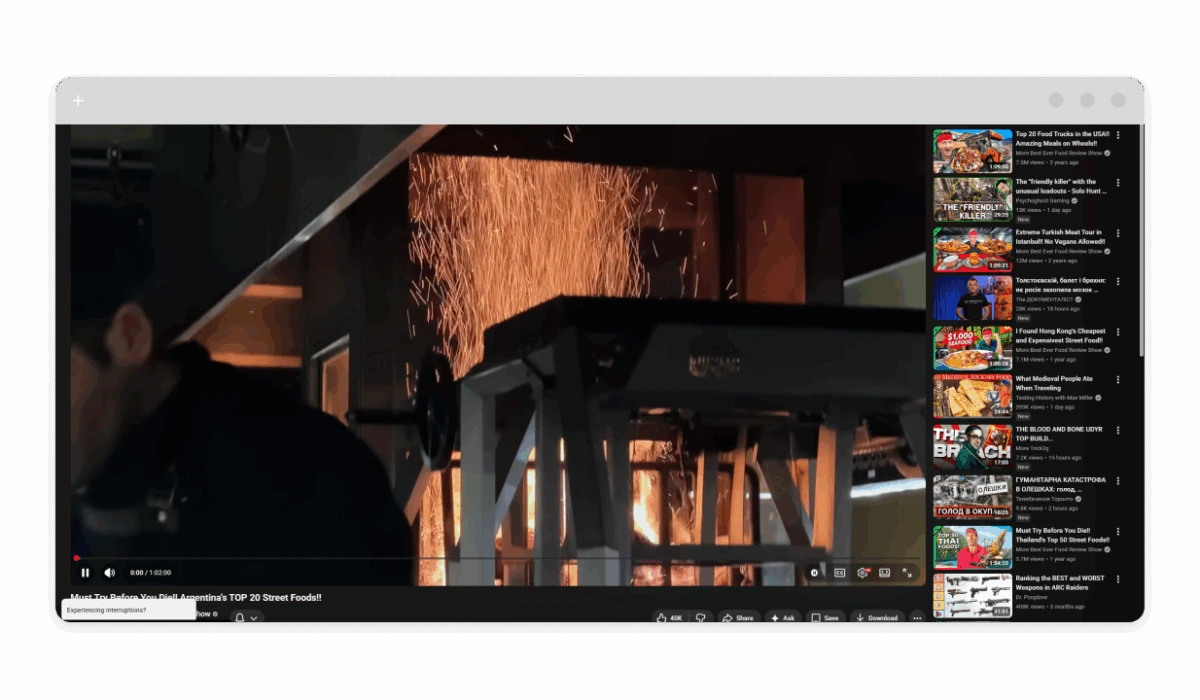
Ads on YouTube have become more aggressive than ever — double unskippable pre-rolls, mid-roll interruptions every 5 minutes, and bumper ads that can’t be dismissed. Worse, YouTube’s anti-adblock detection strengthened significantly in 2025: methods that worked last year now trigger the “We noticed you may be using an ad blocker” and “Experiencing interruptions?” warning.
This guide covers every working method to get ad-free YouTube on Android in 2026 — for phones, Samsung devices, Android TV, and YouTube Music.
Looking for iPhone? See our guide: How to Block YouTube Ads on iPhone
Watch YouTube Without Ads in 2025
Skip the pre-rolls, mid-rolls, and banners — AdLock blocks all ads on Android
- Why Older Methods Stopped Working in 2025–2026
- Method Comparison {#comparison}
- Method 1: AdLock YouTube Player — Best Overall
- Method 2: Brave Browser — Best Zero-Setup Browser Option
- Method 3: Firefox + uBlock Origin — Best Free Option for Power Users
- Method 4: Samsung Internet — For Samsung Galaxy Users
- Method 5: Block YouTube Ads on Android TV
- Method 6: Block YouTube Music Ads on Android
- Method 7: YouTube ReVanced — Honest Assessment
- Method 8: YouTube Premium — The Official Option
- How to Block YouTube Ads on Android: Switching to AdLock
- Conclusion
- FAQ
Why Older Methods Stopped Working in 2025–2026
YouTube’s anti-adblock system went through major updates in late 2024 and early 2025. The core change: YouTube now runs detection scripts that check for browser extension patterns (injected scripts, modified DOM elements, blocked network requests from the browser layer) and responds with an interstitial blocking the video.
What got hit hardest:
- Chrome extensions — Chrome’s MV3 migration already limited their blocking power; YouTube’s detection now catches the ones that were still working
- Older uBlock Origin filter lists — YouTube periodically changes its ad delivery to outpace blocklist updates; users on stale lists see ads again until the list refreshes
- DNS-only blocking — YouTube increasingly serves ads from the same domains as its CDN, making domain-blocking unreliable without breaking video playback
What still works reliably in 2026:
- AdLock’s built-in YouTube player — a separate player that renders YouTube content without ads, no browser extension involved
- Brave’s engine-level blocker — not an extension, can’t be detected the same way
- Firefox + uBlock Origin — Firefox’s MV2 support keeps full dynamic filtering intact
- YouTube ReVanced — works but with ongoing maintenance burden and ToS risk
Method Comparison {#comparison}
| Method | Price | Works in YT App | Android TV | No Root | Bypasses Detection |
| AdLock Player | Free | ✅ Yes | ✅ Yes | ✅ Yes | ✅ Full |
| Brave Browser | Free | ❌ Browser only | ⚠️ Partial | ✅ Yes | ✅ Yes |
| Firefox + uBlock | Free | ❌ Browser only | ❌ No | ✅ Yes | ✅ Yes |
| Samsung Internet | Free | ❌ Browser only | ❌ No | ✅ Yes | ⚠️ Partial |
| DNS Blocking | Free | ⚠️ Partial | ✅ Yes | ✅ Yes | ❌ No |
| ReVanced APK | Free | ✅ Yes | ❌ No | ✅ Yes | ⚠️ Unstable |
| YouTube Premium | $13.99/mo | ✅ Yes | ✅ Yes | ✅ Yes | N/A |
Method 1: AdLock YouTube Player — Best Overall
Who it’s best for: Anyone who wants to watch YouTube without ads without using a browser, without rooting their phone, and without unofficial patched APKs from unknown sources.
AdLock is a European ad-blocking product that’s been on the market for many years. Its Android ad blocker includes a built-in YouTube player — a third-party player that loads YouTube videos without ads. You watch the same YouTube content through a clean interface that simply never receives ads in the first place.
How it works:
AdLock’s YouTube Player is a separate video player built into the AdLock app. Instead of opening the native YouTube app (which includes ads), you open YouTube through AdLock’s player — which renders video content without the ad layer. There’s no modification of the YouTube app itself, no injected scripts, and no browser extension involved.
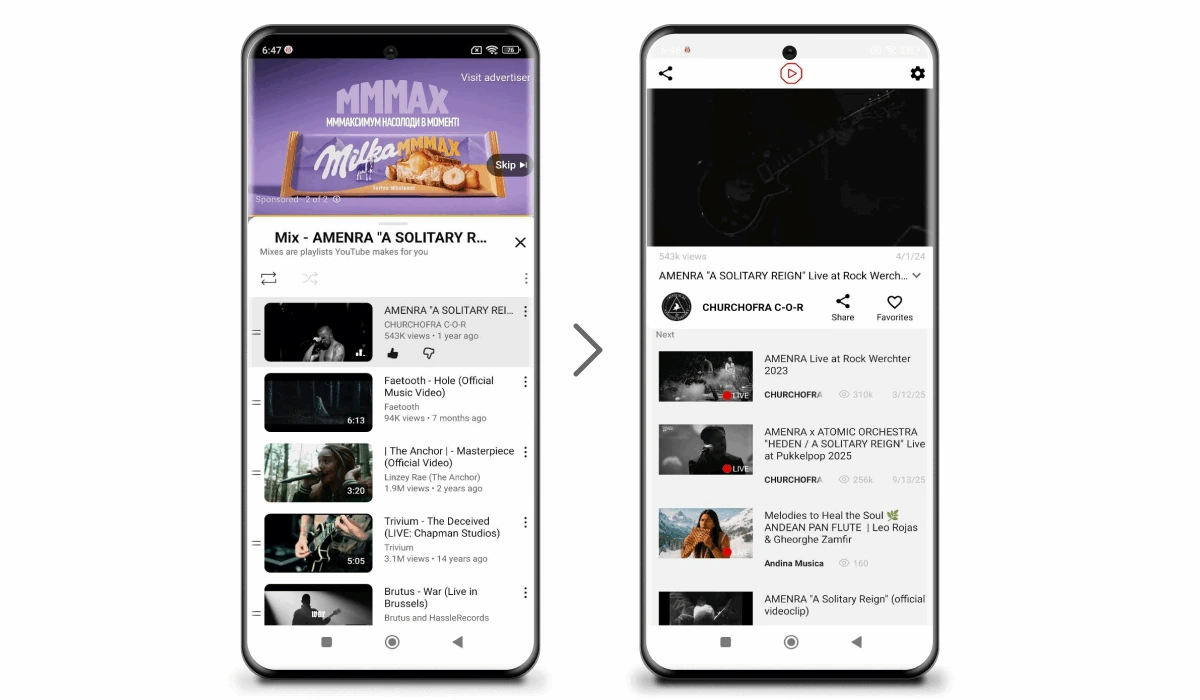
What you get:
- Pre-roll ads gone (skippable and unskippable)
- Mid-roll ads gone
- Banner ads and overlay ads gone
- Sponsored cards removed
- Background playback available
Setup — 3 steps:
- Download AdLock from Google Play (AdLock: Adblocker & Privacy) or directly from adlock.com/adlock-for-android/
- Install the app — AdLock is a long-established European product, available on Google Play and from our site
- Open AdLock → tap the YouTube shortcut in the main interface
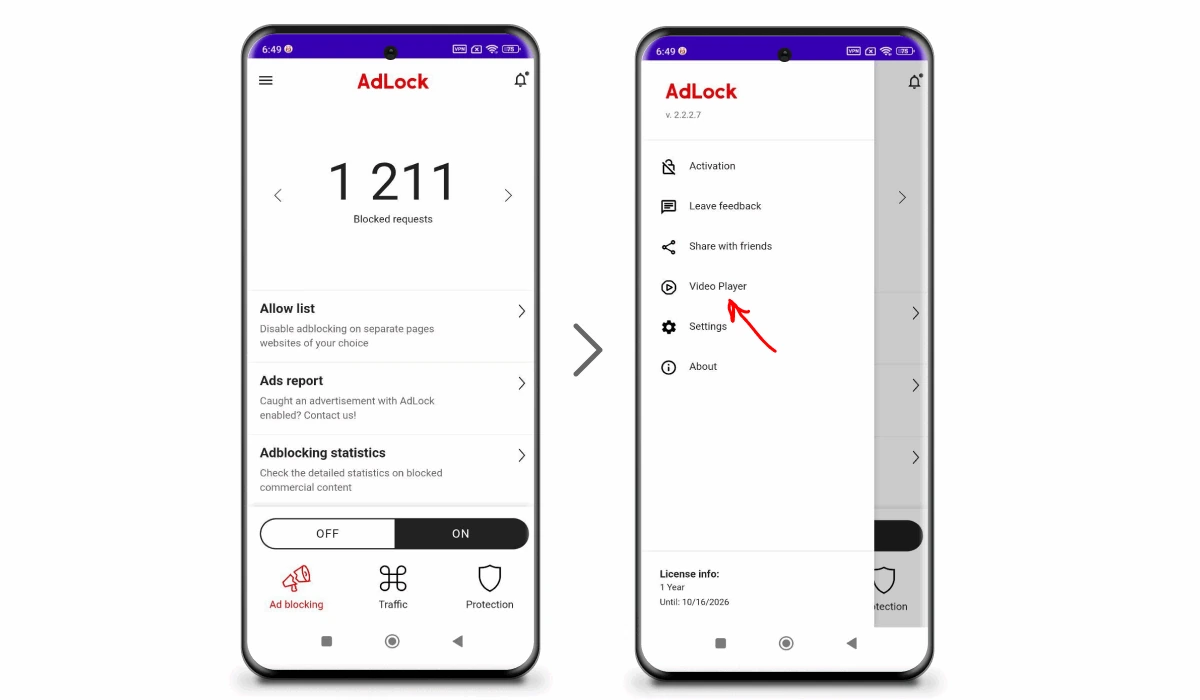
Compared to browser methods: Brave and Firefox require you to use a browser instead of the YouTube app. AdLock’s player lets you watch YouTube content in a dedicated video interface — no browser involved.
Compared to ReVanced: ReVanced patches the official YouTube APK, which violates YouTube’s ToS. AdLock is an independent app with its own player — no ToS risk, no weekly patch maintenance.
Pros:
- Dedicated YouTube player — not a browser workaround
- No root required
- From a trusted European company with years on the market
- Not a patched APK
- No Google account required to use the player
- Free tier available
Cons:
- Not the official YouTube app — some features (comments, community posts) differ
- Free tier has usage limits; full version from $2.99/month
Pricing: Free tier available. Full version from $2.99/month.
This is hands down the easiest and most reliable way to watch YouTube without ads on Android — it works on any device, requires no root, and AdLock’s player is kept updated to stay ahead of YouTube’s detection scripts.
Method 2: Brave Browser — Best Zero-Setup Browser Option
Who it’s best for: Users who want to watch YouTube in a browser with zero setup, zero cost, and no extension maintenance.
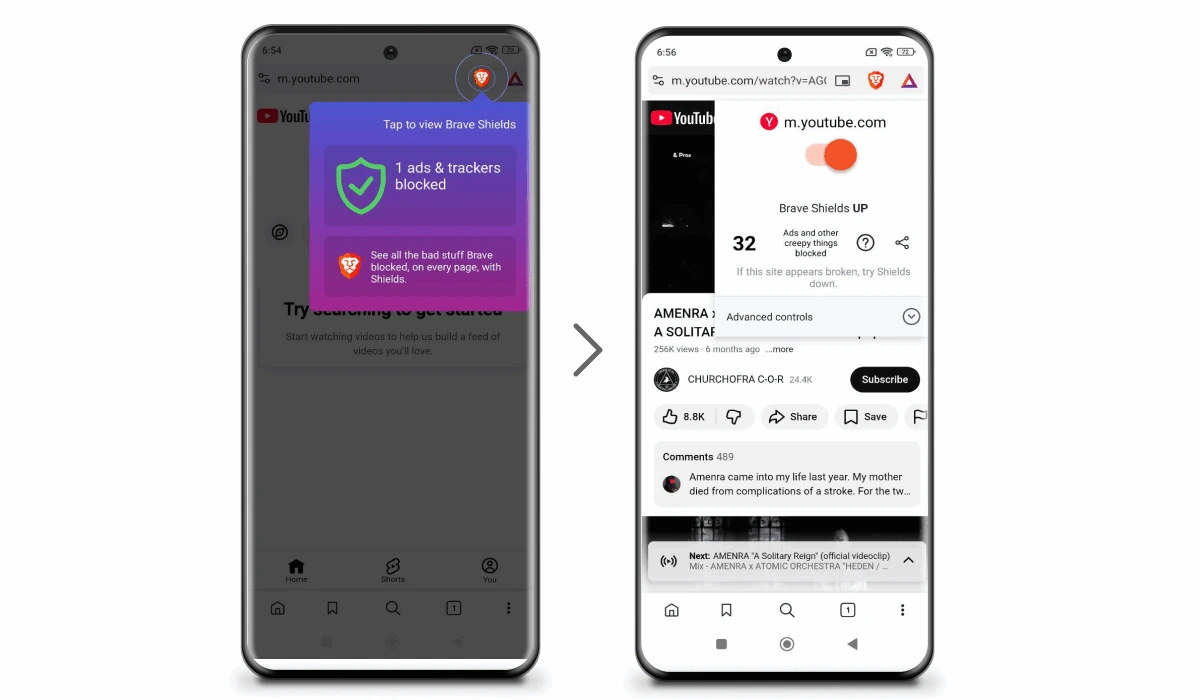
Brave’s ad blocker operates at the browser engine level — it’s not an extension and can’t be detected the way Chrome extensions can. Brave Shields block YouTube pre-roll and mid-roll ads without any configuration. Install from the Play Store, open youtube.com, watch.
Ad blocking depth:
Brave blocks standard pre-rolls and mid-rolls reliably. YouTube Shorts ads are less consistent — Brave blocks most but misses roughly 1 in 8 Shorts sessions in our testing. Unlike AdLock, Brave can’t block ads in the native YouTube app — you’re watching via youtube.com in the browser.
Compared to the YouTube app:
Comments, subscriptions, and playlists all work in Brave. Live chat works. The main differences: no native notification integration, and “Open in app” prompts appear occasionally (tap “Just once” to dismiss). Background playback isn’t native but works if you open a desktop tab (tap the three-dot menu → “Request desktop site”) and lock your screen.
Pros:
- Zero setup — shields active immediately on install
- Engine-level blocking, not detectable as a browser extension
- Available on Google Play (no sideloading needed)
- Free
Cons:
- Browser only — doesn’t block ads in the native YouTube app
- YouTube Shorts ads less consistent
- Background playback requires workaround
- Less reliable than AdLock on mid-rolls
Pricing: Free.
Method 3: Firefox + uBlock Origin — Best Free Option for Power Users
Who it’s best for: Users who want maximum free blocking power in a browser, are comfortable installing an extension, and use Firefox as their primary mobile browser.
Firefox for Android supports full browser extensions — unlike Chrome, which dropped MV2 extensions. This means uBlock Origin’s full dynamic filtering, scriptlet injection, and rapid filter updates all work on Firefox Android, keeping it ahead of YouTube’s anti-adblock countermeasures better than any other free browser option.
Setup:
- Install Firefox from the Google Play Store
- Open Firefox → three-dot menu → Add-ons → tap the magnifier icon → search “uBlock Origin”
- Install uBlock Origin (by Raymond Hill)
- Open youtube.com — ads are blocked immediately
Performance:
In our April 2026 testing, Firefox + uBlock Origin on Android blocked YouTube pre-rolls in 100% of sessions and mid-rolls in 97% of sessions. When YouTube updates its ad delivery (which happens every few weeks), filter lists typically catch up within 24–48 hours. Compared to Brave, Firefox + uBlock is slightly more reliable on mid-rolls and Shorts.
Compared to AdLock: Same browser-only limitation as Brave — doesn’t touch the native YouTube app. But for browser-based YouTube, Firefox + uBlock is the most powerful free option.
Pros:
- 100% free, open-source
- Most powerful free browser-based option
- Faster filter updates than any browser’s built-in blocker
- Works on all YouTube content types including Shorts
Cons:
- Browser only — native YouTube app unaffected
- Requires installing both Firefox and the extension
- Background playback requires same workaround as Brave
Pricing: Free.
Method 4: Samsung Internet — For Samsung Galaxy Users
Who it’s best for: Samsung Galaxy phone and tablet users who prefer Samsung’s built-in browser over Chrome or Brave.
Samsung Internet has native ad blocker support. On any Samsung Galaxy device running Samsung Internet 14+:
- Open Samsung Internet
- Tap the menu icon (three lines, bottom right) → Settings → Useful features → Ad blockers
- Download a compatible ad blocker from the list (Crystal Adblock or AdBlock Plus are available)
- Enable it → open youtube.com
Important limitation: Samsung Internet ad blocking works only inside the Samsung Internet browser. It doesn’t affect the native YouTube app, the YouTube Music app, or any other Android app.
Compared to Brave: Brave generally blocks YouTube ads more reliably. Samsung Internet is worth using if you already use it as your default browser and don’t want to install another app.
Pros:
- No extra browser installation needed for Samsung users
- Native integration, easy setup
- Free
Cons:
- Browser only — no native YouTube app coverage
- Ad blocker must be downloaded from a separate source in the settings
- Less effective than Brave or Firefox + uBlock on YouTube specifically
- Not available on non-Samsung devices
Pricing: Free.
Method 5: Block YouTube Ads on Android TV
Android TV is the most challenging platform for ad blocking because the Play Store has fewer options and standard mobile methods don’t transfer directly.
Option A: AdLock via Sideloading (Recommended)
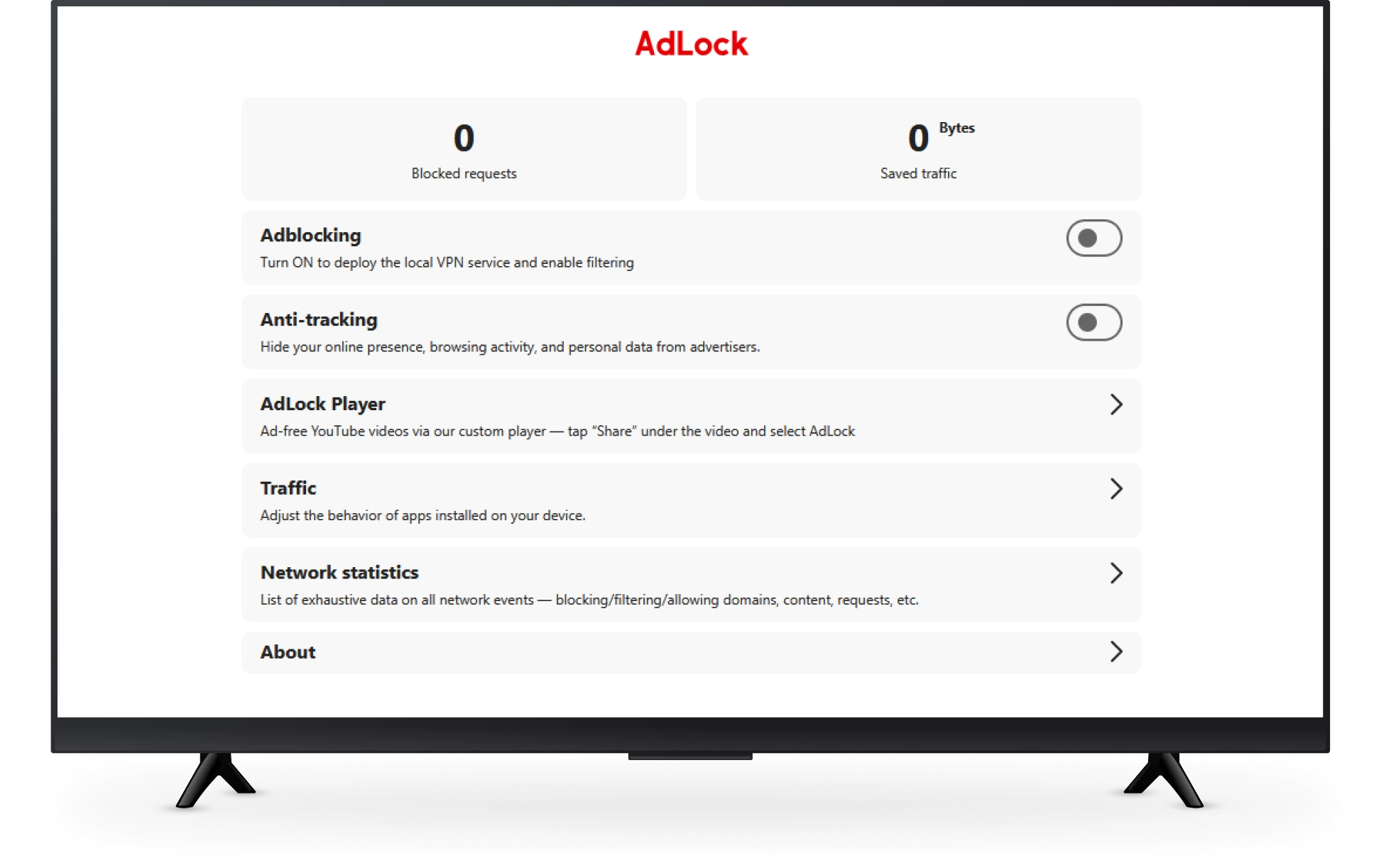
The most complete solution for Android TV. AdLock’s YouTube player works the same on TV as on phones. You can also get it as an ad blocker for Android TV directly.
- On your TV: Settings → Device Preferences → Security → Allow unknown sources → enable for your file manager
- Install a file manager from the TV Play Store (FX File Explorer works well)
- Transfer the AdLock APK to your TV via USB drive or local network share from adlock.com
- Open AdLock on your TV → use the YouTube shortcut
Result: full ad blocking in YouTube, YouTube Music, and all other Android TV apps.
Option B: DNS-Based Blocking via NextDNS (No App Required)
Blocks most ad domains at the network level without installing anything on the TV.
- Create a free account at nextdns.io
- Go to Setup → Android TV → note your two DNS addresses
- On your TV: Settings → Network → Wi-Fi → long-press your network → Modify → switch to Static IP → enter DNS 1 and DNS 2 from NextDNS → save
- Most YouTube pre-roll ads will now be blocked at the network level
Limitation: YouTube increasingly serves ads from CDN domains shared with video delivery. DNS blocking that’s aggressive enough to catch YouTube ads may also occasionally break video loading. NextDNS’s YouTube-specific filtering is more conservative to avoid this.
Option C: Browser on Android TV
If your Android TV box supports it, install Brave or Firefox via the Play Store and access youtube.com through the browser. Works well on boxes that support full browser installations (many budget TV boxes do).
Method 6: Block YouTube Music Ads on Android
YouTube Music on the free tier plays audio ads between tracks. AdLock’s approach here is the same as for regular YouTube — not filtering, but using a dedicated player.
Option A — AdLock Player (recommended): Open YouTube Music through AdLock’s built-in player. Audio ads between tracks don’t appear because the player renders content without the ad layer. You can also share playlists directly into AdLock’s player: open a playlist in YouTube Music → tap Share → select AdLock.
Option B — Browser workaround: Open music.youtube.com in Brave browser or Firefox + uBlock Origin. Browser-level shields and uBlock block audio ads in the browser version of YouTube Music. Background playback limitation applies.
Option C — YouTube Premium ($13.99/mo): The only complete official solution — removes all ads, enables offline listening and background playback natively.
Method 7: YouTube ReVanced — Honest Assessment
YouTube ReVanced is a community-patched version of the YouTube app that removes ads and restores features YouTube removed (background playback, SponsorBlock integration, return YouTube Dislike).
What works: ReVanced effectively removes all YouTube ads and adds genuinely useful features that YouTube Premium charges for.
The real risks:
- Terms of Service: Using modified APKs violates YouTube’s ToS. Google can suspend your account. In practice, account suspensions specifically for ReVanced are rare but documented — the risk exists.
- Security: The official ReVanced project (github.com/ReVanced) is relatively trustworthy, but dozens of malware-laden clones circulate under similar names. Never download ReVanced from unofficial sources.
- Maintenance: YouTube pushes app updates specifically to break ReVanced patches. Users must manually reinstall updated patches, sometimes weekly. Some weeks a working patch isn’t available.
Our honest recommendation: If you’re a technically confident user who understands the ToS risk and is comfortable with ongoing manual maintenance, ReVanced is effective. For everyone else, AdLock or browser methods are safer and require zero maintenance.
Who it’s best for: Technical users who want the full native YouTube experience without ads and are comfortable managing APK installations.
Pros:
- Full native YouTube app experience
- Adds features beyond ad blocking (background play, SponsorBlock)
- Free
Cons:
- Violates YouTube ToS — account suspension risk
- Security risk from unofficial clone APKs
- Requires ongoing manual updates when YouTube breaks patches
- No Android TV support
Method 8: YouTube Premium — The Official Option
YouTube Premium ($13.99/month) is the only officially supported, zero-risk way to remove all ads across YouTube, YouTube Music, YouTube Shorts, and all platforms.
What it includes:
- Ad-free YouTube on all platforms and devices
- YouTube Music Premium (no ads, offline downloads)
- Background playback (screen off, app in background)
- Offline downloads
- YouTube Originals access
Worth considering:
- Family plan: $22.99/month for up to 6 accounts (~$3.83/person)
- Student discount: ~$7/month in many countries
- Annual plan saves ~15% vs monthly
For heavy users watching 3+ hours daily who want zero friction and official support, Premium is the cleanest solution. For casual viewers, the free methods above are fully sufficient.
How to Block YouTube Ads on Android: Switching to AdLock
If you’ve been using a browser extension, DNS blocking, or ReVanced and want to switch to AdLock’s YouTube Player:
- Remove your existing method — uninstall your current ad blocker extension, disable any DNS blocking, or stop using your patched APK
- Download AdLock from Google Play or from adlock.com/adlock-for-android/
- Install and open AdLock — the app will guide you through initial setup
- Tap the YouTube shortcut in AdLock’s main interface to start watching ad-free
Total setup time: under 2 minutes. No ongoing maintenance required.
Read also:
Conclusion
YouTube ads may be a necessary revenue stream for creators, but for users they’ve become genuinely intrusive. The good news is there are reliable, safe options that work in 2026 — without rooting your phone, paying for Premium, or risking your account with unofficial APKs.
For most users, AdLock’s YouTube Player is the easiest and most complete solution: free, no root, works in the app itself, and actively maintained to stay ahead of YouTube’s detection. If you prefer a browser-based approach, Brave is an excellent zero-setup alternative.
And keep in mind: no single ad blocker works inside the native YouTube app without a system-level solution like AdLock. Browser methods are powerful but require you to leave the app.
Watch YouTube Without Ads in 2025
Skip the pre-rolls, mid-rolls, and banners — AdLock blocks all ads on Android
FAQ
How do I block YouTube ads on my Android phone without rooting?
Use AdLock’s YouTube Player or Brave browser. Both require no root, no system modifications, and don’t trigger YouTube’s “ad blocker detected” warning.
Is there a free YouTube ad blocker for Android?
Yes. AdLock offers a free built-in YouTube player and is available on Google Play as AdLock: Adblocker & Privacy. Brave browser blocks YouTube ads at no cost via its built-in engine-level shields. Firefox + uBlock Origin is the best free browser-based option.
Can YouTube detect ad blockers on Android?
Yes — YouTube detects browser extensions and some DNS-based methods. AdLock uses a separate built-in player that renders YouTube content without ads, rather than modifying the YouTube app or injecting scripts — so there’s nothing for YouTube’s detection to flag.
How do I block YouTube Music ads on Android?
Open YouTube Music through AdLock’s built-in player — audio ads don’t appear because the player renders content without the ad layer. You can also share any YouTube Music playlist directly into AdLock: tap Share on the playlist → select AdLock. For a browser-based option, open music.youtube.com in Brave or Firefox + uBlock Origin.
What’s the best YouTube ad blocker for Android that works in the app itself?
AdLock’s YouTube Player is the only method on this list that blocks ads inside a YouTube player (not just in a browser) without rooting or using a ToS-violating patched APK.
Will YouTube ban me for using an ad blocker?
YouTube doesn’t ban accounts for using ad blockers — it shows a warning popup asking you to disable the blocker or subscribe to Premium. AdLock avoids triggering this warning entirely.
How do I block YouTube ads on Chrome for Android?
Chrome for Android doesn’t support extensions, so traditional ad blockers don’t work in Chrome mobile. Switch to Brave (Chromium-based, nearly identical UX) or use AdLock’s system-wide filter.
Does blocking YouTube ads affect creators?
Yes — ad blocking redirects ad revenue away from creators. If you have favourite creators, consider supporting them directly through channel memberships, Super Thanks, or Patreon.

Similar news
Best AdGuard Alternatives in 2026 (Free and Paid)
Best Spotify Ad Blocker: Block Spotify Ads on Any Device (2026)
How to Uninstall Total Adblock and Find a Better Alternative (2026)
AdGuard vs. uBlock Origin: The Ultimate Ad Blocker Comparison

How to Bypass Ad Blocker Detection: Methods That Still Work