How to Block Ads on Dailymotion (Browser + Mobile App)
Dailymotion runs pre-rolls, mid-rolls, and banner ads on nearly every video. Most browser ad blockers handle these just fine — until Dailymotion updates its ad delivery system and your extension stops catching anything. If you want to watch Dailymotion without ads reliably, you need to know which methods still work and which ones Dailymotion has learned to route around. This guide covers all of them: desktop browsers, the Dailymotion mobile app, Android, iOS, and DNS-level blocking.
Watch Dailymotion Without Interruptions
Say goodbye to mid-roll and popup ads. AdLock keeps videos clean and smooth
Why Are There Ads on Dailymotion
Dailymotion is an ad-supported platform. Advertising funds content creator payouts and keeps the service running. The result for viewers: pre-roll ads before videos, mid-rolls that interrupt longer content, and banner overlays on the player. Unlike YouTube, Dailymotion doesn’t offer an official ad-free subscription tier for viewers — so if you want Dailymotion with no ads, a third-party blocker is the only real path.
Why Your Dailymotion Ad Blocker May Have Stopped Working
Dailymotion updated its ad delivery system in 2025, making browser extensions a lot less effective. If your ad blocker suddenly stopped catching Dailymotion ads, one of three things probably happened.
Extension detection. Dailymotion’s scripts scan the page for patterns common to browser extensions — injected DOM elements, blocked script requests, hidden bait elements that extensions typically interact with. When they find a match, Dailymotion reroutes ad delivery through alternative paths. Most standard Chrome and Firefox extensions are now detectable this way.
Server-side ad insertion (SSAI). Some Dailymotion videos use SSAI, where ads are stitched directly into the video stream on the server before it reaches your device. There’s no separate ad network request to intercept — the ad and the video arrive as a single stream. Browser extensions can’t block these at all, and even system-level tools only partially handle them.
Manifest V3. Chrome’s MV3 update stripped real-time network request blocking from browser extensions. This weakened nearly every Chrome-based ad blocker simultaneously, and Dailymotion’s 2025 changes took advantage of the gap.
What still works: system-level blockers like AdLock (which runs outside the browser entirely), DNS-level blocking for non-SSAI ads, and uBlock Origin on Firefox with up-to-date filter lists. What no longer works reliably: most Chrome extensions, and any filter list that hasn’t been updated since early 2025.
How to Watch Dailymotion Without Ads Using AdLock
AdLock works differently from a browser extension. It filters traffic at the network level — before ad requests reach the browser or app. Dailymotion’s detection scripts look for browser extension fingerprints; AdLock doesn’t have any, because it doesn’t run inside the browser. That’s why it bypasses the “ad blocker detected” warning that trips up most extensions.
On Desktop (Windows and Mac)
Install the AdLock desktop app on Windows or macOS. It intercepts ad requests at the system level, covering all browsers at once — Chrome, Firefox, Edge, or any other. No per-browser configuration needed. Open Dailymotion in any browser, and ads are blocked immediately. The app also handles tracker blocking and HTTPS filtering, which covers encrypted ad traffic that plain DNS blocking misses.
On Android
AdLock for Android uses a local VPN filter to intercept ad requests before they reach any app — including the Dailymotion app. No root required. Download it from adlock.com or find it on Google Play as AdLock: Adblocker & Privacy, enable the local VPN filter when prompted, turn on HTTPS filtering to cover encrypted traffic, and open the Dailymotion app. Ads are blocked from that point on, with no Dailymotion-specific configuration needed.
On iPhone and iPad (iOS)
AdLock for iOS installs a DNS content blocker that covers known ad domains system-wide. It catches most Dailymotion pre-rolls. Mid-rolls delivered via SSAI may occasionally slip through — that’s an Apple sandboxing limitation, not a blocker failure. For the most complete coverage on iOS, watch Dailymotion in Safari with AdLock’s content blocker active rather than using the native app, since Safari content blocking is more comprehensive than DNS-only filtering.
Dailymotion Ad Blocker Detected
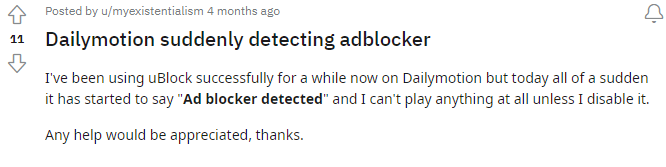
If Dailymotion shows a warning that your ad blocker has been detected and blocks video playback, the issue is almost always extension fingerprinting. Dailymotion’s scripts use “bait” DOM elements — hidden nodes that browser extensions interact with — to confirm a blocker is active, then restrict access to content.
AdLock avoids this entirely. Because it operates at the network level and has no presence inside the browser, there’s nothing for Dailymotion’s scripts to detect. Clearing browser cookies regularly and declining non-essential cookies on Dailymotion also reduces tracking-based detection for extensions that you continue using alongside AdLock.
Dailymotion Ad Blocker Extensions for Chrome and Firefox
Extensions are the path of least resistance — install once, start blocking. On Firefox, uBlock Origin remains the strongest option and actively maintains Dailymotion-specific filter lists. On Chrome, the MV3 migration cut into everyone’s effectiveness, but extensions still block a significant share of standard ad formats.
AdLock’s Chrome extension is free and blocks the most common Dailymotion ad formats without any setup. Like every Chrome extension post-MV3, it shares the same limitations when Dailymotion routes ads through SSAI. If you’re hitting that wall — ads playing through the extension — the standalone AdLock app is what closes the gap. It handles traffic outside the browser and outside Chrome’s extension policy entirely.
Read also:
Other Ways to Get Dailymotion No Ads
DNS Blocking
DNS-level blocking filters ad requests before they connect to an ad server — no app installation on the device itself required, just a DNS setting change. NextDNS lets you configure a custom DNS resolver with ad-blocking lists. Create a NextDNS account, add a blocklist (the default recommended list covers most ad domains), and point your device or router’s DNS to the NextDNS resolver address. It works across every browser and app on the network simultaneously. DNS blocking won’t touch SSAI ads, but it handles standard Dailymotion ad formats cleanly and costs nothing for light use.
Disable Ads in Dailymotion Studio (Partners Only)
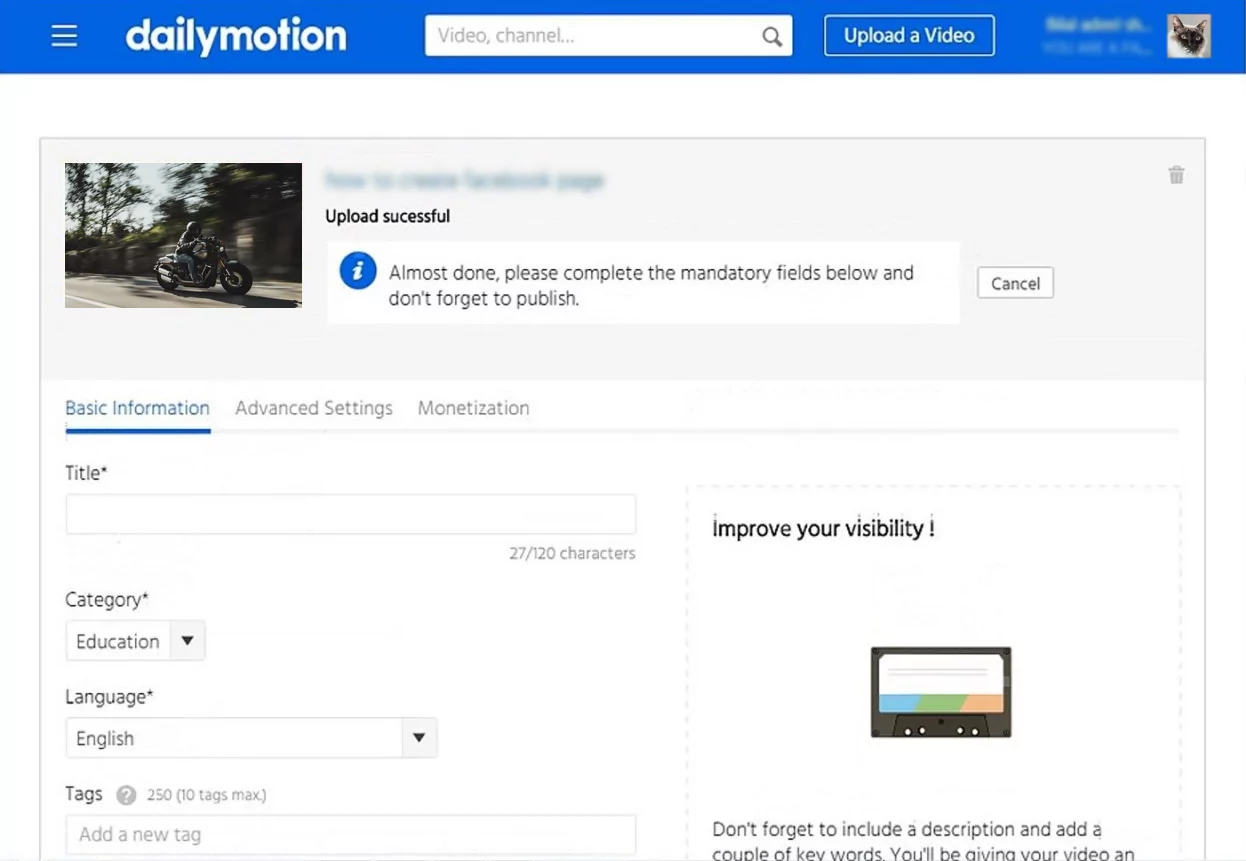
If you upload content as a Dailymotion partner, you can turn off monetization per video. Log in to Dailymotion Studio, go to Media > Videos, select the video, open Advanced settings, scroll to the Monetization section, uncheck the option, and click Save. This only affects your own uploads — it does nothing for viewers watching other creators’ content.
Raw HTML5 Player Script
A Tampermonkey script from Greasy Fork can replace Dailymotion’s default player with a raw HTML5 player, stripping ads that are embedded in the player itself. Install the Tampermonkey browser extension, search Greasy Fork for a Dailymotion HTML5 player script, and install it. This works for some video types but doesn’t help with SSAI or mid-rolls baked into the content stream. It’s worth trying as a free option, but it’s not a complete solution.
Dealing with ads on other platforms too? Here’s how to stop Pinterest ads using the same logic.
Watch Dailymotion Without Interruptions
Say goodbye to mid-roll and popup ads. AdLock keeps videos clean and smooth
Frequently Asked Questions
Why does Dailymotion say my ad blocker is detected?
Dailymotion runs JavaScript checks that look for browser extension fingerprints — injected scripts, hidden bait DOM elements that extensions interact with. Most standard Chrome and Firefox extensions trigger these checks. AdLock bypasses them because it operates at the network level and has no presence inside the browser for Dailymotion’s scripts to find.
How do I block Dailymotion ads on iPhone?
Install AdLock for iOS. It configures a DNS-based content blocker that works system-wide. For the most complete results, watch Dailymotion in Safari rather than the native app — Safari content blocking is more comprehensive than DNS-only filtering on its own.
Does AdLock work on the Dailymotion mobile app?
On Android, yes — AdLock’s local VPN filter intercepts ad requests before they reach the Dailymotion app. On iOS, AdLock provides DNS-level blocking across all apps including Dailymotion, though SSAI mid-rolls may occasionally slip through due to Apple’s sandboxing limits.
Why are Dailymotion ads not blocked even with an ad blocker?
The most likely cause: Dailymotion is using server-side ad insertion (SSAI), which stitches ads into the video stream before delivery. There’s no separate ad request to intercept, so browser extensions can’t catch them. System-level tools like AdLock handle more cases than extensions, but SSAI is a genuine limitation across all client-side blockers.
Can I watch Dailymotion with no ads for free?
Dailymotion doesn’t offer an official ad-free subscription for viewers. Free options include AdLock’s Chrome extension, uBlock Origin on Firefox, or NextDNS with an ad-blocking list. For coverage across both browsers and apps without configuration hassle, AdLock’s paid standalone app is the most complete option.
Does Dailymotion have an adblock workaround built in?
Yes. Dailymotion actively detects browser-based ad blockers and may restrict video playback when one is found. It also uses server-side ad insertion on some content, which sidesteps blockers at the delivery level. These are the two main reasons why a Dailymotion adblock setup that worked a year ago may not work today.
Conclusion
Getting Dailymotion no ads takes more than installing a basic browser extension. For browser-only use, uBlock Origin on Firefox or AdLock’s Chrome extension cover most standard ad formats. For the Dailymotion mobile app or complete device-wide coverage, AdLock’s standalone app filters traffic at the network level — the only approach that reliably bypasses both detection scripts and non-SSAI ads. DNS blocking through NextDNS is a solid free option for network-level filtering without installing anything on each device. Pick the method that fits your setup, and don’t expect any single tool to catch 100% of ads — SSAI is a real limitation across the board.

Similar news

Best AdGuard Alternatives in 2026 (Free and Paid)
Best uBlock Origin Alternatives in 2026 (Especially for Chrome)

How to Use a Redirect Blocker in Chrome, Firefox, Edge, and Safari
How to Stop Sites from Opening New Tabs Automatically

How to Bypass Ad Blocker Detection: Methods That Still Work