Government Spyware Is Now Delivered Through Online Ads
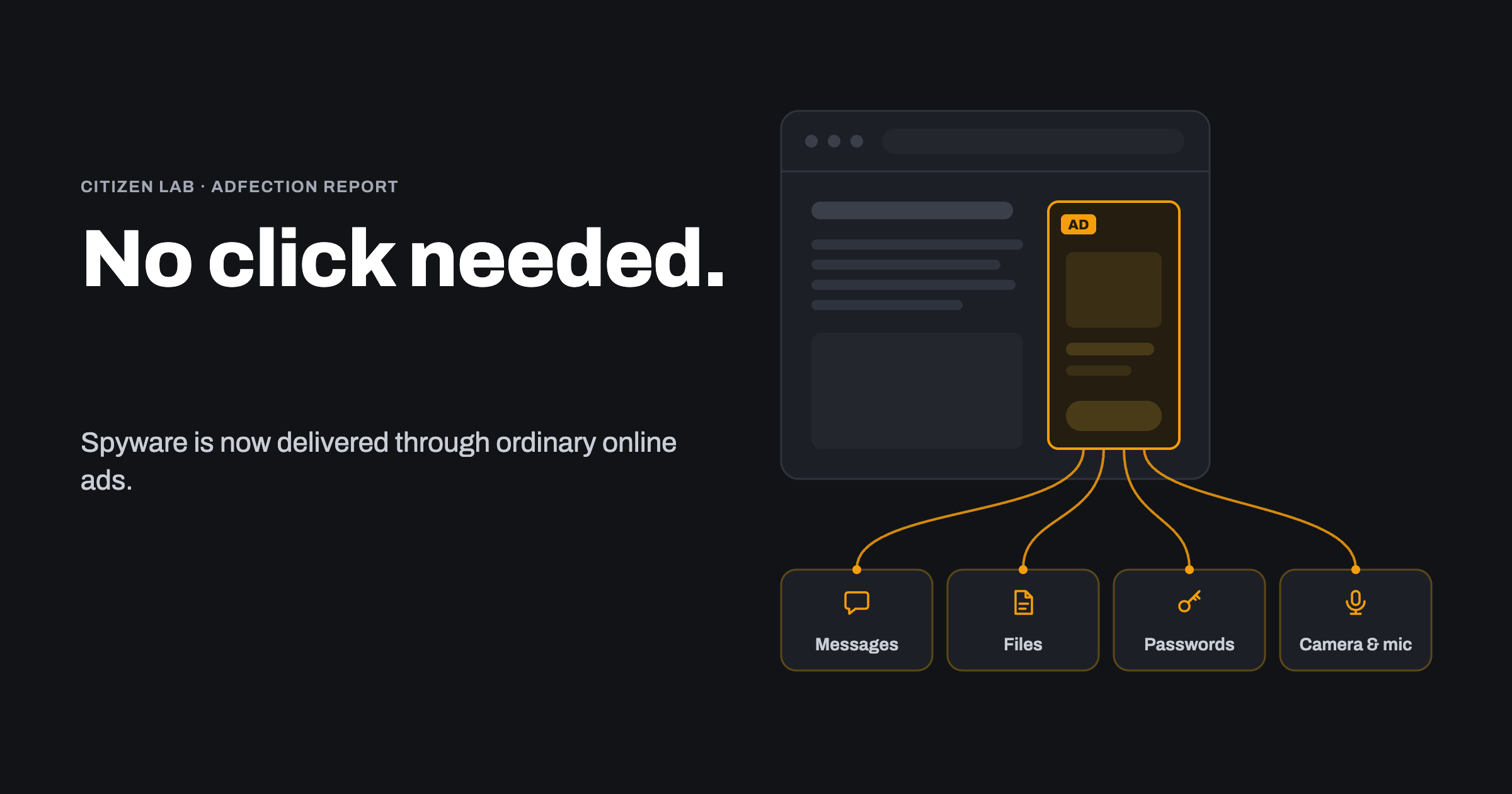
On October 15, Citizen Lab, the digital rights research lab at the University of Toronto, published a report on something people in my field have warned about for years but could never quite prove. Government-grade spyware was delivered to devices through ordinary online ads. No link to click. No attachment to open. The ad just had to load.
This report is a big deal. The technical evidence is solid, and the lead researcher’s own advice was to block ads. Here’s what happened, what it means for individuals and organizations, and where an ad blocker is not a magic shield.
What Citizen Lab Found
The researchers named the technique AdFection. At its center is Discover-Tech, an Israeli company that presents itself as a normal advertising firm. Citizen Lab describes it as “a bridge between mercenary spyware companies and the advertising ecosystem.”
Discover-Tech’s platform, Controlium, let its customers target specific devices with malicious code, and profile and fingerprint those devices along the way. The spyware maker Candiru, an Israeli vendor that sells surveillance tools to governments, was tied to the campaign through its DevilsTongue Windows malware.
The confirmed victim is the media organization Al Jazeera, which provided evidence of attacks on at least 45 devices across 2024 and 2025. Citizen Lab couldn’t say which governments were behind the attacks, but called this the first concrete technical proof of government spyware delivered through online ads.
How a Zero-Click Ad Attack Works
This is the part worth understanding, because it explains why the attack is so quiet.
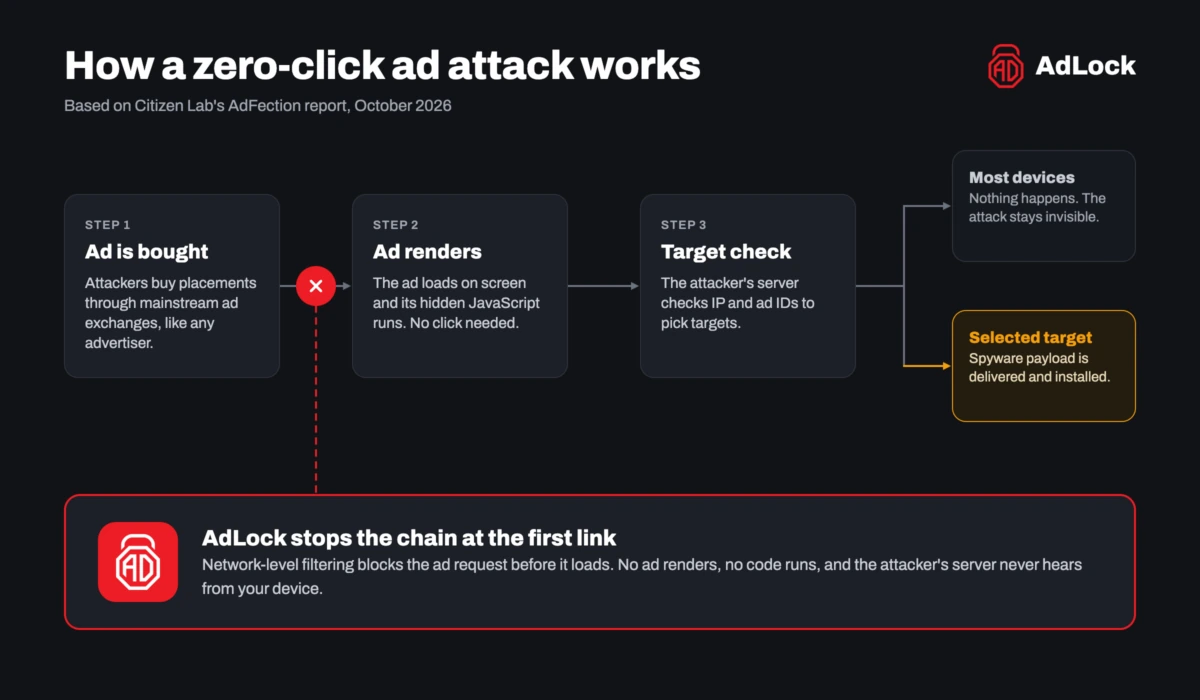
- The operator buys ad placements through mainstream ad networks and exchanges, the same pipes every advertiser uses.
- The ad carries JavaScript. When it renders on screen, that code quietly contacts the attacker’s server.
- The server checks whether this device is a target, using signals like the IP address and ad identifiers. Most devices are irrelevant and get nothing.
- Selected targets get the payload. Only the chosen devices receive the next stage of malicious code, which keeps the whole operation stealthy.
The key word is “render.” You don’t click anything. You don’t interact. The ad appearing on screen is enough for the first stage to run. That’s what zero-click means here, and it’s why ordinary caution doesn’t help.
For a sense of scale: between March and June 2026, the operation placed 3.77 billion bids and won 442 million ad auctions. Those aren’t infection numbers, since most of it was reconnaissance. But they show how far the ad pipeline let the attackers reach.
Why This Is a Real Escalation
Malvertising isn’t new. We’ve written before about fake Homebrew ads that pushed credential-stealing malware to developers. What’s new here is who’s using it and how precisely.
Ad networks are built to target people by location, device, interests, and employer. That’s their whole value to advertisers. But the same machinery that puts a running-shoe ad in front of runners can put malicious code in front of a specific device inside a specific organization.
And the reach went well beyond one newsroom. The exposed bidding records show these ads displayed on devices inside militaries, government agencies, critical infrastructure, and national cyber agencies. Researchers at Confiant, who worked with Citizen Lab, also found potentially malicious ads on the networks of the International Atomic Energy Agency and the International Criminal Court.
Citizen Lab is careful to say it’s unclear whether those displays led to infections. But the delivery route clearly reached them. The ad network isn’t the villain here. It’s the delivery system, and it reaches almost every connected device on earth.
What an Ad Blocker Does Here
The AdFection chain starts with one event: the ad rendering and its JavaScript running. Break that first link and nothing else happens.
A network-level ad blocker filters the ad request before the ad, and its code, ever loads. No ad, no JavaScript, no call to the attacker’s server. AdLock works this way. It filters at the network and JavaScript level across every app and browser on the device, rather than living inside one browser as an extension. That’s also why the Manifest V3 changes, which cut what browser extensions can block, didn’t affect it.
This isn’t a fringe recommendation. CISA, the US cybersecurity agency, includes ad blocking in its guidance to federal agencies on defending against malvertising. The FBI has publicly advised using an ad blocker since 2022. And the lead Citizen Lab researcher, Bill Marczak, put it plainly in an interview with TechCrunch:
“If you might be targeted based on who you are or what you do, it’s time to disable ad tracking on your devices or even block ads altogether.”
What This Means for Organizations
For companies and public institutions, the uncomfortable takeaway is that the ad ecosystem is now a way into managed devices. EDR, MDM, and patching all still matter. But none of them stop a browser or an app from loading an ad, and the ad is where this attack starts.
Filtering ads at the device level across the whole fleet removes that route as a category. It doesn’t rely on employees spotting anything, because in a zero-click attack there’s nothing to spot.
Backed by ten years of consumer device protection, we’re now bringing the same filtering to corporate and government environments, including web filtering for business. If you protect a fleet of devices and this vector is on your radar, we’d like to hear from you.
Where an Ad Blocker Is Not Enough
Now the limits, because overselling this would be exactly the wrong move.
If you are a high-value target, such as an investigative journalist, a dissident, or a senior official, an ad blocker shrinks your attack surface but isn’t a full defense against a well-funded government operation. Those targets need layered protection: hardened devices, lockdown modes, separate devices for sensitive work, and professional security support. Blocking ads removes one major delivery route. It doesn’t make anyone immune.
For most people, who will never be singled out by a nation-state, the takeaway is still real. Malvertising also runs broad campaigns pushing everyday malware to ordinary users. Taking ads out of the equation closes off that whole category of risk in the background.
What to Do
- Block ads at the network level. This closes the route AdFection relied on. An ad blocker that works across apps and browsers, not just one browser, gives the widest coverage.
- Turn off ad tracking and personalization on your devices and accounts. Less targeting data means less precision for anyone trying to single you out.
- Keep your OS and apps updated. Zero-click chains rely on vulnerabilities, and patches close them.
- If you could be a target, get real help. Turn on your platform’s lockdown mode and contact a security professional or a group like Access Now’s Digital Security Helpline.
- For organizations: treat ad filtering as endpoint hardening. It belongs alongside EDR and MDM, not as a personal preference left to each employee.
“Don’t click suspicious links” is no longer enough advice. When an ad can compromise a device just by loading, the ad itself is the attack surface. Not loading it is one of the few defenses fully in your hands.
Ads shouldn’t be an attack surface. AdLock blocks ads and malicious ad code across your apps and browsers.
Frequently Asked Questions
In this campaign, yes, for selected targets. Citizen Lab documented malicious code running when an ad simply rendered on screen, with no click or interaction. It’s rare and targeted, not something that happens to everyone who sees an ad, but the mechanism is now proven.
It removes the delivery route. The attack starts with an ad loading and its code running, and a network-level ad blocker stops the ad from loading at all. For most people that closes the risk. For high-value targets it’s one layer among several, not a complete defense.
Yes. CISA includes ad blocking in its malvertising guidance for US federal agencies, and the FBI has publicly recommended using an ad blocker since 2022. The Citizen Lab researchers behind this report gave the same advice.
The confirmed compromise was Al Jazeera, with at least 45 devices. The ads also reached devices on military, government, and critical infrastructure networks, plus the IAEA and the International Criminal Court. Citizen Lab says it’s unclear whether those displays resulted in infections.
You’re very unlikely to be individually targeted by government spyware. But the same malvertising machinery runs broad campaigns pushing ordinary malware to ordinary people. Blocking ads closes off that category of risk regardless of who you are.
Sources
- Citizen Lab: Exposing AdFection
- TechCrunch: Governments are hacking people with zero-click spyware by showing them online ads
- BleepingComputer: Targeted ads installed Candiru spyware in zero-click attacks
- CISA: Securing Web Browsers and Defending Against Malvertising for Federal Agencies
- FBI IC3: Public Service Announcement on malicious search engine ads (December 2022)

Latest news

How to Block Annoying Ads on Business Insider Once and For All

How to Block Annoying Ads on Bloomberg Once and For All

How to Block Annoying Ads on Los Angeles Times Once and For All

How to Block Annoying Ads on New York Post Once and For All

How to Block Annoying Ads on Reuters Once and For All